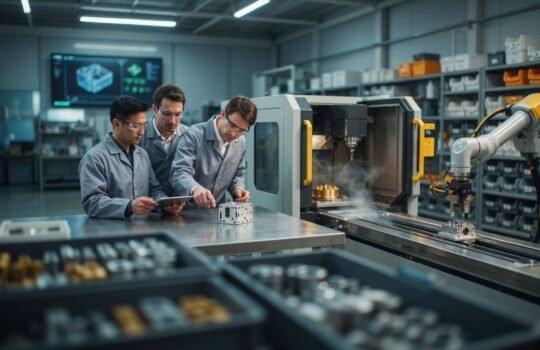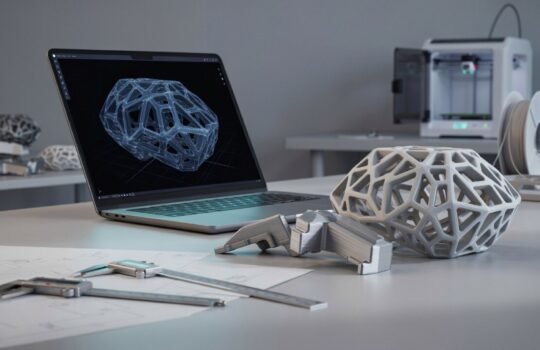
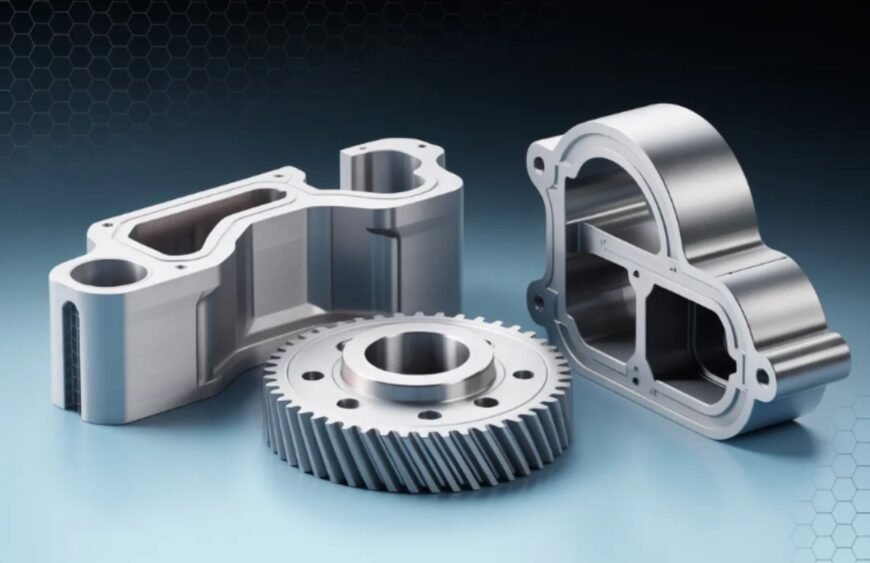
When engineers and product teams look for a material that balances mechanical strength, flexibility, and chemical resistance, nylon consistently comes out on top. In the context of additive manufacturing, nylon particularly processed through Selective Laser Sintering (SLS) has reshaped how automotive and industrial components are designed, prototyped, and produced.
At Tesseract, a full-service 3D printing service in Mumbai, we work with engineering teams across automotive, robotics, defence, and industrial sectors. Across hundreds of projects, nylon parts repeatedly prove their worth where standard FDM plastics fall short.
This blog breaks down exactly how nylon 3D printing works, what makes it ideal for demanding applications, and how it fits within a broader industrial product designing and manufacturing workflow.
What Is Nylon 3D Printing and How Does It Work?
Nylon (polyamide) is a semi-crystalline engineering thermoplastic known for its toughness, fatigue resistance, and ability to absorb mechanical impact without fracturing.
The SLS Process Explained
The most widely used method for nylon 3D printing in industrial settings is Selective Laser Sintering (SLS). Here is how the process works:
- A thin layer of nylon powder is spread across the build platform
- A high-powered CO₂ laser selectively fuses the powder particles layer by layer according to the CAD design
- Unfused powder acts as a natural support structure, eliminating the need for additional support material
- Once the build is complete, parts are recovered from the powder bed and post-processed for surface finish or functionality
This process makes SLS ideal for complex geometries, interlocking assemblies, and thin-walled structures that other manufacturing methods struggle to produce.
Nylon Variants Used in Industrial 3D Printing
Different nylon grades serve different performance requirements:
- PA 12 (Nylon 12): The most commonly used grade in SLS, with excellent chemical resistance, good surface finish, and dimensional stability
- PA 11 (Nylon 11): Higher ductility and impact strength, preferred for parts requiring flexibility
- Glass-Filled Nylon: Enhanced stiffness and heat resistance for load-bearing components
- Carbon Fibre-Filled Nylon: High stiffness-to-weight ratio, suitable for structural automotive brackets and aerospace-grade fixtures
Key Material Properties That Make Nylon Ideal for Automotive & Industrial Applications
Understanding why nylon outperforms standard materials requires a look at its core properties:
- High tensile strength and fatigue resistance capable of withstanding repeated stress cycles without failure
- Temperature resistance maintains structural integrity at elevated operating temperatures
- Chemical and fuel resistance suitable for under-the-hood automotive components exposed to oils, coolants, and solvents
- Low coefficient of friction ideal for moving parts, gears, bushings, and sliding assemblies
- Moisture absorption management can be controlled through post-processing and material selection between PA 11 and PA 12
These properties position nylon as one of the few polymer materials trusted for end-use parts, not just prototypes.
Automotive Applications of Nylon 3D Printing
The automotive sector has been one of the earliest and most consistent adopters of nylon additive manufacturing. At Tesseract, our automotive clients leverage nylon for both prototype validation and functional end-use components.
Common Automotive Use Cases
- Intake manifolds and ducting nylon’s heat and chemical resistance make it viable for fluid-handling components
- Snap-fit housings and clips have complex retention features that would require expensive tooling in conventional moulding
- Dashboard and interior panels lightweight structural parts with fine surface detail
- Jigs, fixtures, and assembly tools low-volume production tooling that accelerates assembly line workflows
- Functional prototypes for design validation, shortening the gap between industrial product designing and physical testing
How Nylon 3D Printing Compares to Injection Moulding for Automotive Parts
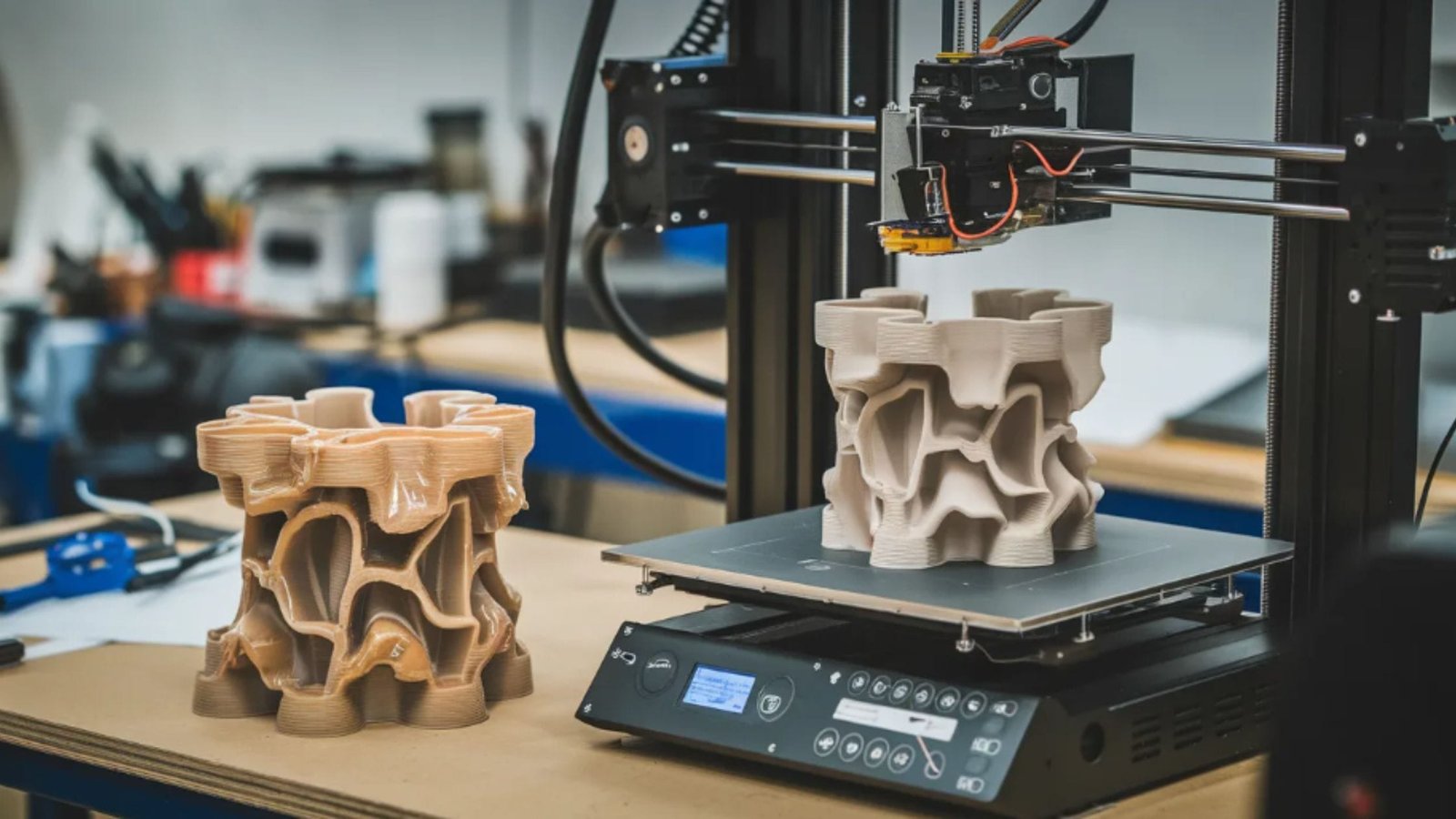
For low-to-medium volume runs, nylon 3D printing eliminates the cost and lead time of hard tooling. When production volume scales, a hybrid approach using 3D-printed parts for initial builds and transitioning to injection moulding is a workflow Tesseract actively supports across its manufacturing capabilities.
Industrial Applications Beyond Automotive
Nylon’s utility extends well beyond automotive. Industrial sectors that regularly rely on nylon 3D-printed parts include:
- Robotics and automation grippers, brackets, and end-of-arm tooling where weight reduction is critical
- Defence ruggedised components with tight dimensional tolerances
- Medical devices and equipment housings, biocompatible nylon grades for non-implant applications
- Consumer electronics enclosures and functional housings require both strength and fine surface detail
- Aerospace ground support equipment, lightweight structural components for non-flight hardware
In all of these sectors, the ability to iterate rapidly without retooling costs is a decisive advantage that direct 3D printing services provide over traditional manufacturing.
Nylon 3D Printing vs Other Industrial Manufacturing Methods
To understand where nylon additive manufacturing delivers the most value, it helps to compare it directly with complementary processes.
Nylon SLS vs Vacuum Casting
Vacuum casting is ideal for producing small batches of parts in polyurethane materials with silicone moulds. However, when part geometry is highly complex or when nylon-specific mechanical properties are required, SLS is the more appropriate choice. Tesseract offers both vacuum casting service and SLS-based nylon printing, allowing engineering teams to select the right process for each project phase.
Nylon SLS vs Direct Metal Laser Sintering (DMLS)
Direct metal laser sintering uses a similar powder-bed fusion principle but works with metal alloys. Where weight reduction is paramount, and metal strength is not required, nylon parts are significantly lighter and more cost-effective. For applications requiring metal-grade strength and thermal performance, Tesseract’s DMLS service, also known as Direct Metal Laser Sintering, is the appropriate route. Many projects use both: nylon for iteration and validation, DMLS for final production-grade metal components.
When to Consider Nylon Over FDM
FDM printing with standard filaments is cost-effective for visual models and simple functional tests. However, nylon SLS parts offer isotropic mechanical properties, meaning they perform consistently in all directions a critical requirement for load-bearing industrial components that FDM parts typically cannot meet.
The Role of Industrial Product Design in Nylon Part Performance
A part is only as good as its design. Nylon SLS unlocks design freedom that traditional manufacturing cannot match, but realising that freedom requires expert DFM (Design for Manufacturability) guidance.
Tesseract’s industrial product design team works with clients from initial concept through production-ready files. This includes:
- Wall thickness optimisation for SLS printing
- Feature consolidation to reduce assembly count
- Stress analysis and geometry refinement for fatigue-critical parts
- File preparation and tolerance management for tight-fit assemblies
Poor design decisions, such as overly thick walls that cause warping or unsupported spans that collapse, are caught and corrected before a single layer is printed. This DFM consulting capability is one of Tesseract’s core differentiators as a 3D printing service in Mumbai.
Why Partner with Tesseract for Nylon 3D Printing?
Tesseract operates as a complete product development partner, not simply a 3D printing bureau. For automotive and industrial clients, this means:
- Access to multiple technologies under one roof: SLS, FDM, SLA, DMLS, DLP, PolyJet, and more
- In-house industrial product designing and DFM consulting
- Complementary services include vacuum casting, CNC machining, injection moulding, and sheet metal fabrication
- Proven track record with clients across automotive, robotics, defence, medical, and consumer sectors
- Fast turnaround and quick quotation for time-sensitive development cycles
Whether you need a single prototype or a production batch, Tesseract’s integrated manufacturing setup ensures continuity from concept to final part.
Frequently Asked Questions
What is the difference between nylon FDM printing and nylon SLS printing?
FDM nylon involves extruding filament layer by layer and requires support structures. SLS fuses nylon powder with a laser, producing parts with superior mechanical isotropy, better surface finish, and no support material, making it far more suitable for functional industrial parts.
Is nylon 3D printing suitable for end-use automotive parts or only prototypes?
Nylon printed via SLS is routinely used for end-use parts in automotive, including fluid-handling components, housings, clips, and assembly fixtures. The suitability depends on the specific loads, temperatures, and chemical exposure the part will face.
How does nylon 3D printing compare to vacuum casting for industrial parts?
Vacuum casting is well-suited for small batches of polyurethane parts with good surface finish. Nylon SLS is preferred when true nylon material properties are required, when geometry is too complex for silicone moulds, or when batch sizes exceed what vacuum casting can economically deliver. Tesseract offers both services.
When should I use DMLS instead of nylon 3D printing?
Direct Metal Laser Sintering is the right choice when parts must withstand high thermal loads, require metal-grade tensile or yield strength, or need to function in environments where polymer materials would degrade. Nylon and DMLS are often used together across different stages of a single project.
Can Tesseract handle both the design and manufacturing of nylon parts?
Yes. Tesseract’s team provides end-to-end support from industrial product designing and DFM consulting through to printing, post-processing, and delivery. Clients can engage at any stage of the product development cycle.
What industries does Tesseract serve with nylon 3D printing?
Tesseract works across automotive, robotics and automation, defence, medical technology, consumer electronics, and aerospace support applications, among others.