When a component fails in the field, be it in aerospace, automotive, or medical, the cost isn’t just financial. It’s downtime, safety risk, and lost trust. For engineers and product developers who need parts that perform under pressure, metal 3D printing is changing what’s possible. At Tesseract, a full-service 3D printing service in Mumbai, we’ve seen firsthand how the right technology and material combination transforms the way industrial components are built.
What Is Metal 3D Printing?
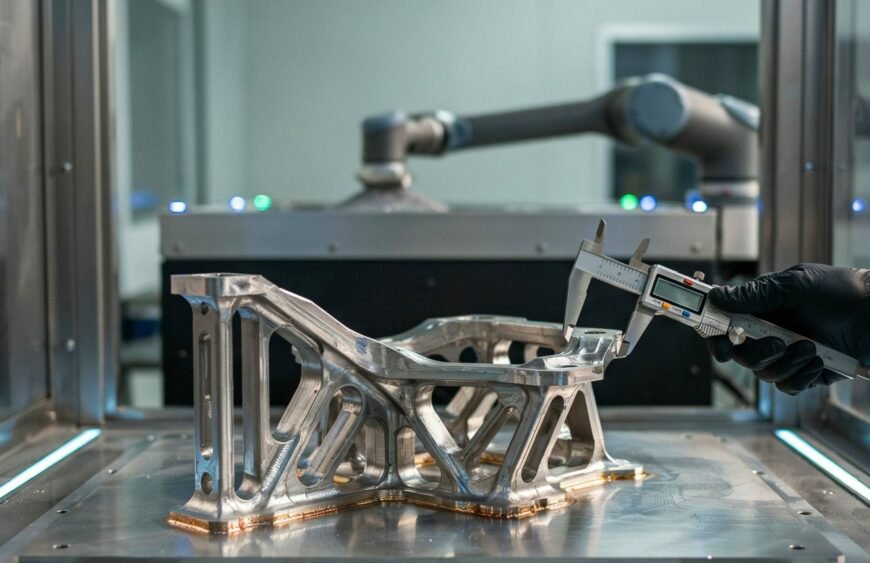
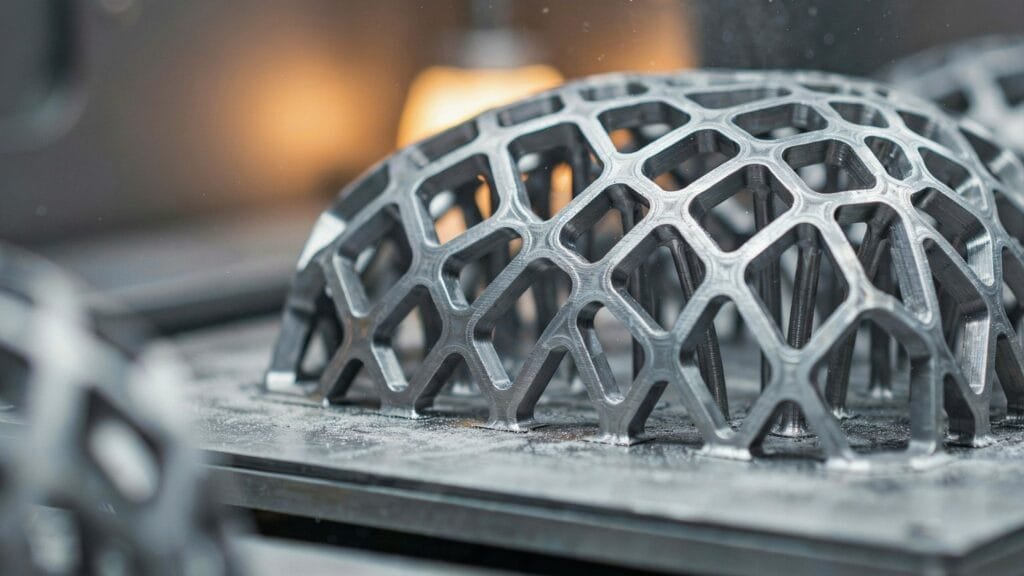
Metal 3D printing, specifically Direct Metal Laser Sintering (DMLS), uses high-wattage lasers to micro-weld powdered metals and alloys layer by layer into fully functional metal structures. Unlike traditional subtractive manufacturing, it builds from the ground up, which means complex internal channels, organic geometries, and lattice structures that would be impossible to machine are now achievable in a single print run.
Tesseract’s DMLS service supports a wide range of metals:
- Aluminum AlSi10Mg: good strength, hardness, and thermal properties with low weight
- Stainless Steel 316L: high corrosion resistance, toughness, and ductility
- Titanium Ti64: excellent mechanical properties, low weight, and biocompatibility
- Cobalt Chrome MP1: high mechanical performance at elevated temperatures, nickel-free
- Nickel Alloy IN625: high tensile and creep strength, heat and corrosion resistant
- Maraging Steel MS1: excellent hardness and strength via simple age-hardening
Each material is selected based on the application’s specific load, thermal, and environmental requirements.
Why Metal 3D Printing Produces Stronger Components
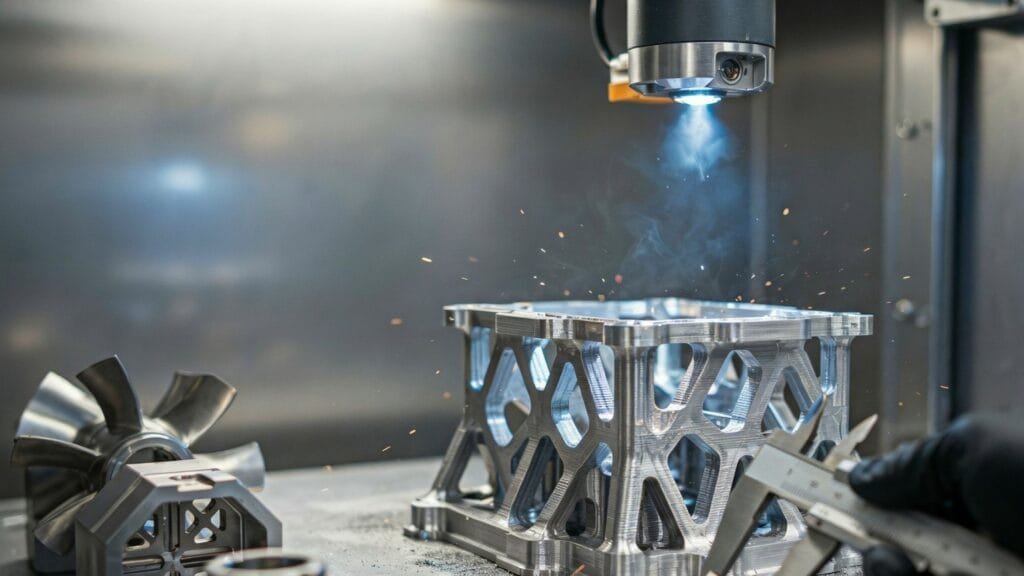
The strength advantage of DMLS comes from how parts are built. The laser sintering process produces denser parts compared to conventional casting or machining, with fewer internal voids and better grain uniformity. This translates directly to improved fatigue resistance and mechanical integrity.
Key structural advantages include:
- Ability to integrate complex internal geometries and channels that improve load distribution
- Material-optimised design through topology optimisation and lattice structures
- No tooling-induced stress or directional weakness from machining
- Consistent material properties throughout the part, not just at the surface
Beyond Metal: How the Right Material Choice Matters
Not every industrial component needs to be metal. For functional prototypes, jigs, fixtures, and enclosures, Tesseract also offers Selective Laser Sintering (SLS), the technology behind nylon 3D printing. SLS-printed nylon parts are tough, impact-resistant, and require no support structures, making them a strong choice for complex functional parts that aren’t subject to extreme thermal or mechanical loads.
Choosing between metal and nylon 3D printing comes down to your application’s load-bearing requirements, operating environment, and end-use purpose. Tesseract’s team works through this during the initial consultation and DFM(Design for Manufacturability) review.
The Role of 3D Product Design in Component Performance
A strong component starts with a strong design. Tesseract’s in-house 3d product design team works with clients from the concept stage, ensuring designs are optimised not just for aesthetics but for the manufacturing process and intended use. Poor DFM choices, such as thin wall thicknesses, unsupported overhangs, or wrong material selection, are caught before a single layer is printed.
For clients bringing an existing part, Tesseract also offers 3D Scanning and Reverse Engineering to digitise the component accurately before redesigning or remanufacturing it.
Industries That Rely on Metal 3D Printing
Tesseract’s metal 3D printing service supports industries where component strength and complexity are non-negotiable:
- Aerospace: compact components with complex internal channels and anatomical shapes
- Automotive: lightweight structural parts and functional prototypes
- Defence: high-precision components with tight tolerances
- Medical Technology: biocompatible parts certified to USP Class VI and ISO 10993
- Robotics & Automation: custom brackets, end-effectors, and mechanical assemblies
- Oil & Gas: parts requiring complex internal channels and heat resistance
Post-Processing for Surface Quality and Durability
Straight out of the printer, metal parts may require finishing to meet functional or aesthetic specifications. Tesseract offers anodizing, electropolishing, powder coating, heat treatment, and sand blasting all in-house. This end-to-end capability means fewer handoffs, tighter quality control, and faster delivery.
Why Choose Tesseract for Metal 3D Printing in Mumbai?
Tesseract is one of the few full-stack manufacturing partners in Mumbai with the capability to take a project from CAD to finished component under one roof. With over 105 machines, dedicated DFM consulting, quick quoting, and timely delivery, the focus is on solving real engineering problems, not just printing parts.
Whether you need a single prototype to validate a design or a production batch of functional metal components, Tesseract handles both, with turnarounds typically ranging from a few days to 2–3 weeks depending on complexity.
Explore Tesseract’s DMLS Metal 3D Printing Service or get in touch to discuss your next component.
Frequently Asked Questions
What metals does Tesseract support for 3D printing?
Tesseract’s DMLS service supports Aluminum AlSi10Mg, Stainless Steel 316L, Titanium Ti64, Cobalt Chrome MP1, Nickel Alloy IN625, and Maraging Steel MS1. Material selection is guided by your specific application requirements.
How is metal 3D printing different from CNC machining?
CNC machining removes material from a solid block (subtractive), while metal 3D printing builds the part layer by layer (additive). This allows DMLS to produce complex internal features and geometries that are not possible or cost-effective with CNC machining.
Can Tesseract help if I don’t have a CAD file ready?
Yes. Tesseract offers both product design services and 3D scanning with reverse engineering, so a digital model can be built from scratch or recreated from a physical part before production begins.
What is nylon 3D printing used for in industrial applications?
Nylon 3D printing via SLS is suited for functional prototypes, jigs, fixtures, and end-use parts that require toughness and design complexity without extreme thermal or structural demands. It is a cost-effective alternative to metal for many industrial applications.
Does Tesseract offer post-processing for metal 3D printed parts?
Yes. Post-processing options include anodizing, electropolishing, powder coating, heat treatment, and sand blasting, all handled in-house.
Can Tesseract handle both prototypes and production volumes?
Yes. Tesseract accommodates single-piece prototypes as well as production runs, with turnaround times typically ranging from a few days to 2–3 weeks, depending on part complexity.