If you’re an engineer or product developer in India weighing your manufacturing options, the choice between metal 3D printing and CNC machining comes down to one thing: what does your part actually demand? Both are powerful processes, but they solve different problems. Knowing when to use each can save you time, tooling costs, and unnecessary redesigns.
What Is Metal 3D Printing (DMLS)?
Direct Metal Laser Sintering (DMLS) uses high-wattage lasers to micro-weld powdered metals layer by layer, producing fully functional metal parts directly from a digital 3D model. At Tesseract, we work with materials including Aluminium AlSi10Mg, Stainless Steel 316L, Titanium Ti64, Cobalt Chrome, Nickel Alloy IN625, and Maraging Steel MS1, each suited to specific performance requirements across industries like aerospace, automotive, defence, and medical technology.
CNC Machining vs. Metal 3D Printing: The Core Difference
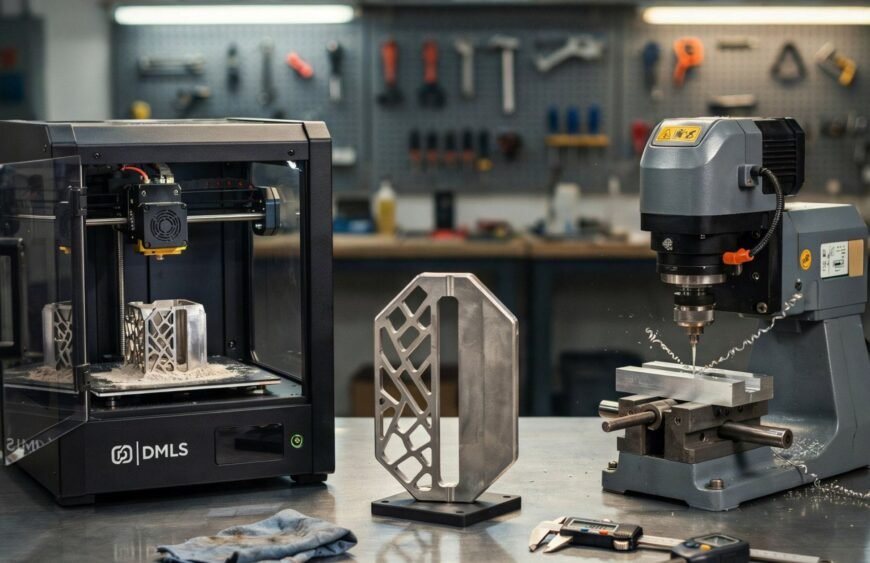
CNC machining is a subtractive process where material is cut away from a solid block. Metal 3D printing is an additive manufacturing process where material is built up layer by layer. This fundamental difference determines which process is right for your project.
When Is Metal 3D Printing the Better Choice
1. Your Part Has Complex Internal Geometry
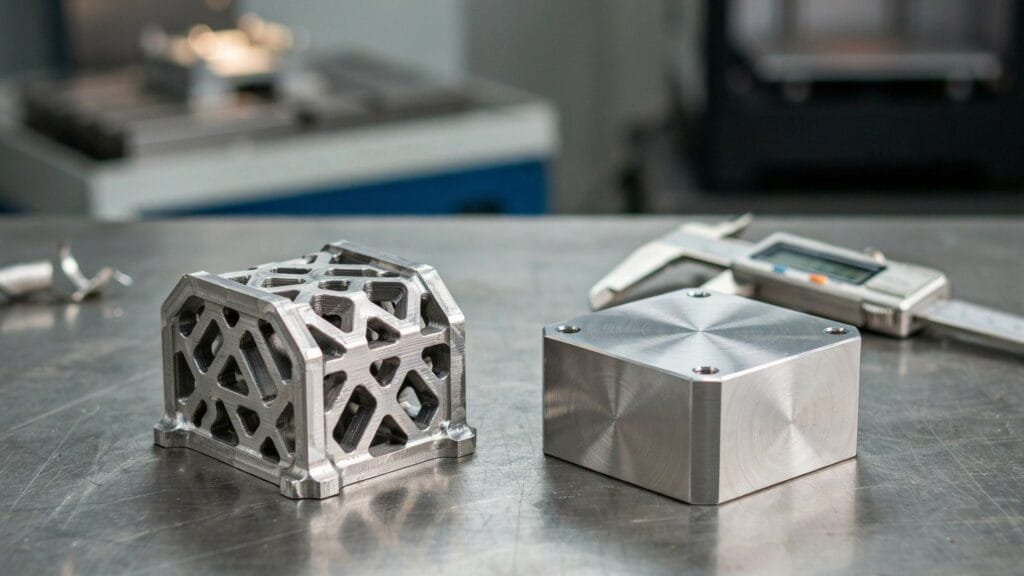
CNC tools can only reach surfaces they can physically access. If your component requires internal channels, lattice structures, conformal cooling passages, or organic anatomical shapes, DMLS is the only viable option without assembly. Metal 3D printing in India produces these features in a single build with no compromise on material density or structural integrity.
2. You’re Working on a Prototype or Low-Volume Run
CNC machining for complex parts often requires custom fixtures and tooling costs that only make sense at volume. With DMLS, no tooling is required. You go directly from a CAD file to a part, making it ideal for:
- Single-piece functional prototypes
- Design validation parts that need real metal properties
- Low-volume production runs where tooling investment isn’t justified
3. Speed to Part Is Critical
When deadlines are tight, DMLS accelerates production significantly. Tesseract handles single-piece prototypes to production runs with turnaround times typically ranging from a few days to 2–3 weeks, depending on complexity, with no tooling delays.
4. You Need Lightweight, High-Strength Components
Aluminium 3D printing (AlSi10Mg) is a strong use case for aerospace and automotive applications where the strength-to-weight ratio matters. DMLS-produced aluminium parts offer good strength, hardness, and thermal properties at low weight, and because the material is only deposited where needed, you can design topology-optimised structures that machining simply cannot produce.
5. Your Design Is Still Evolving
Every design iteration with CNC means re-programming tool paths and potentially new fixtures. With metal 3D printing, you update the digital file and print again. This makes DMLS far more cost-effective through the design iteration phase.
When CNC Machining Still Makes More Sense
Metal 3D printing isn’t the answer for every job. CNC machining is typically preferred when:
- Your part has simple geometry with tight dimensional tolerances that printing can’t match without post-processing
- You’re producing high volumes where per-unit machining cost drops below additive costs
- Surface finish requirements are extremely demanding straight off the machine
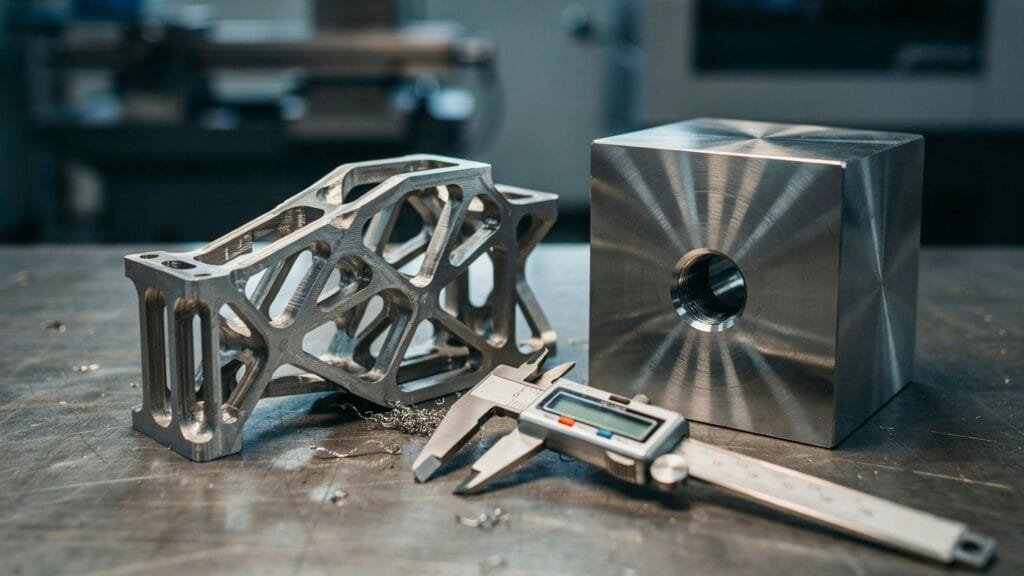
Tesseract offers both CNC machining and DMLS services, which means our team can advise you on the right process for your specific requirement, including hybrid approaches where 3D printed parts are finish-machined for critical features.
Industries Where DMLS Outperforms Machining
Based on the applications we handle at Tesseract, metal 3D printing delivers a clear advantage in:
- Aerospace & Defence: compact components with complex internal channels and high strength requirements
- Medical Technology: biocompatible titanium and cobalt chrome implants; our materials carry USP Class VI & ISO 10993 certifications and support ETO & Gamma Sterilisation
- Oil & Gas: intricate valve and fitting geometries that require dense, corrosion-resistant metal parts
- Automotive & Robotics: lightweight structural components and functional end-use parts
Ready to Decide?
If your part has complex geometry, tight timelines, or no room for expensive tooling, metal 3D printing is likely the smarter call. Explore Tesseract’s DMLS service or upload your design for an instant quote.
Frequently Asked Questions
What is Direct Metal Laser Sintering (DMLS)?
DMLS is a form of metal 3D printing that uses high-wattage lasers to micro-weld powdered metals layer by layer, creating dense, fully functional metal components with complex geometries that traditional manufacturing cannot achieve.
What metals can be 3D printed using DMLS?
Tesseract’s DMLS service supports Aluminium AlSi10Mg, Stainless Steel 316L, Titanium Ti64, Cobalt Chrome MP1, Nickel Alloy IN625, and Maraging Steel MS1.
Is metal 3D printing in India cost-effective for prototypes?
Yes. Because DMLS eliminates tooling, it is significantly more cost-effective than CNC machining for prototype and low-volume runs, particularly for parts with complex geometry.
How long does a DMLS part take to produce?
At Tesseract, turnaround for DMLS parts typically ranges from a few days to 2–3 weeks, depending on part complexity and order volume.
Can DMLS parts be post-processed?
Yes. Tesseract offers a full range of post-processing options, including anodising, powder coating, electropolishing, heat treatment, sand blasting, and buffing/polishing for DMLS parts.
Which industries benefit most from metal 3D printing?
Aerospace, automotive, defence, oil & gas, robotics, and medical technology are primary industries where DMLS provides a performance advantage over conventional manufacturing methods.