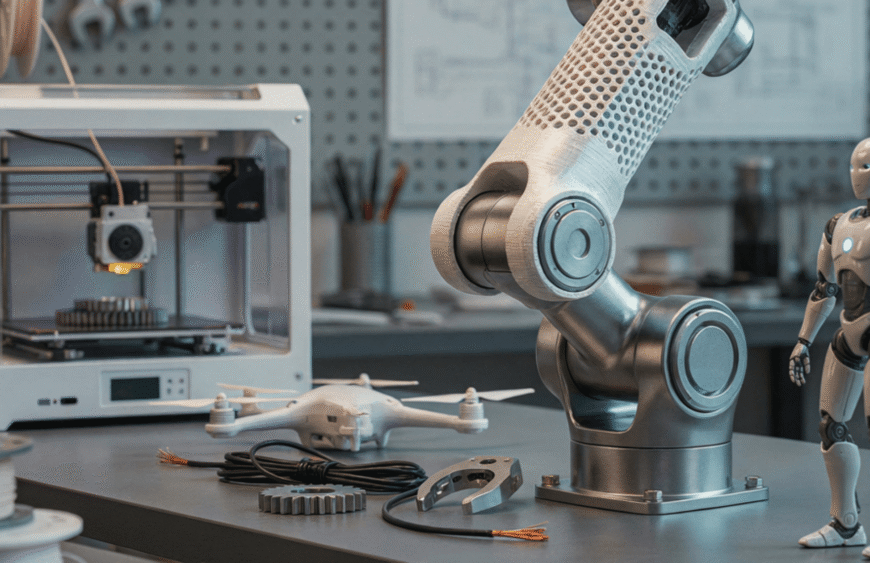
3D printing helps robotics and automation companies build lighter, faster, and more customized components without the tooling delays of traditional manufacturing. From drone frames to custom grippers, additive manufacturing lets engineers iterate on designs in days instead of weeks, using materials that cut weight without sacrificing strength.
Humanoid robots, four-legged machines, insectoid robots, collaborative robots (cobots), and wearable exoskeletons are no longer research-lab experiments; they’re shipping products. That shift has pushed manufacturers to build parts that are lighter and more complex than what CNC machining or injection moulding alone can deliver.
Here’s how 3D printing is solving that problem, and where it fits into a modern robotics production line.
1. Why Lightweight Parts Matter in Robotics
Every gram added to a moving robotic component costs energy, speed, and battery life. In drones and legged robots especially, weight directly limits flight time, payload capacity, and range. Traditional metal or moulded parts are often heavier than they need to be because manufacturing constraints force simpler, solid geometries.
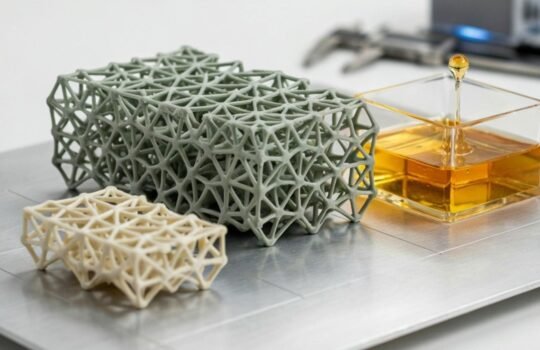
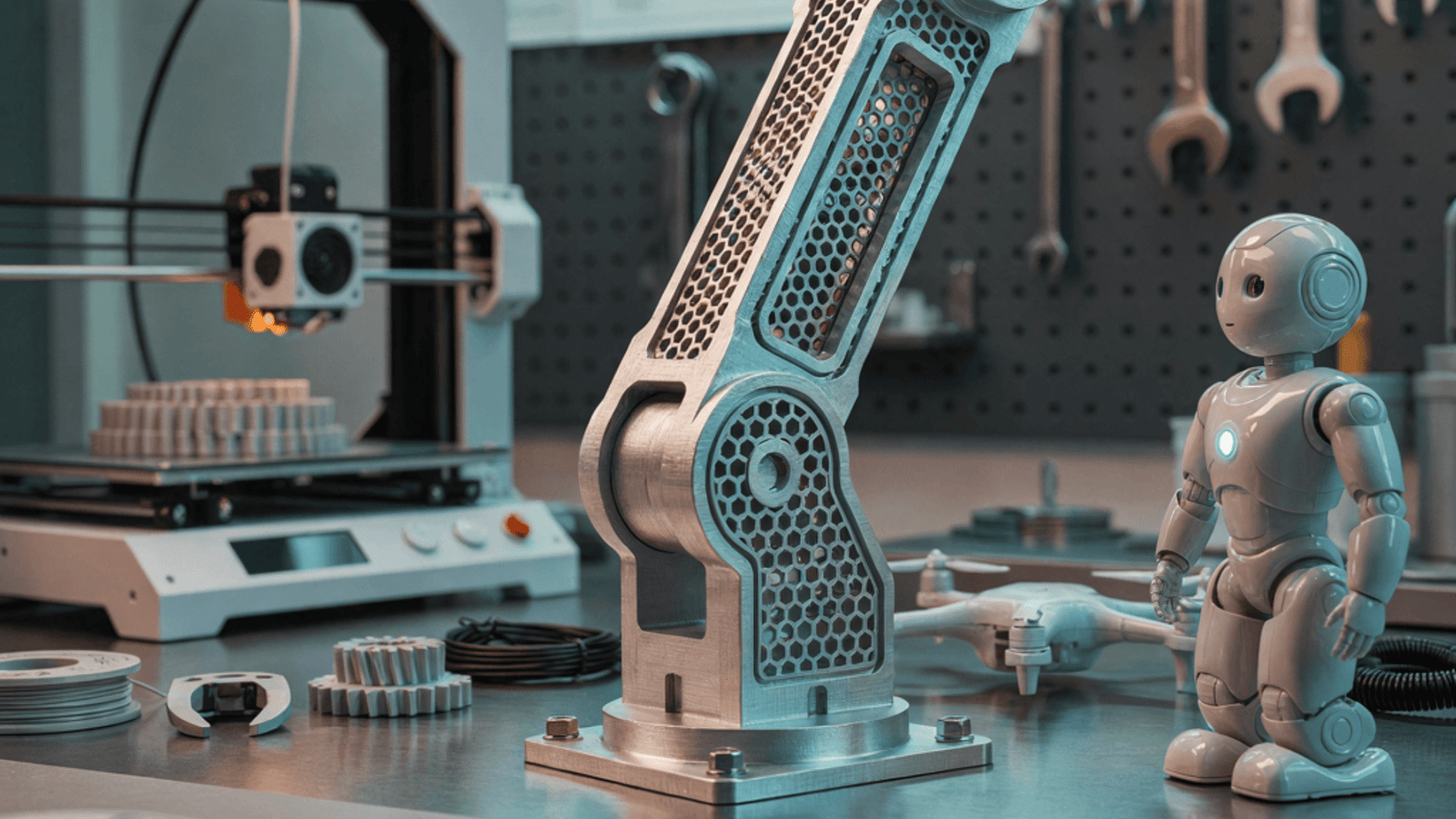
3D printing removes that constraint. Internal lattice structures and hollowed sections can be printed in a single part, carrying the same load as a solid part while weighing a fraction as much.
2. Rapid Prototyping for Faster Design Iteration
Robotics development is iterative by nature. A gripper, joint bracket, or sensor housing rarely works perfectly on the first try, and traditional tooling makes each design change expensive and slow.
With 3D printing, a prototype can move from CAD file to physical part in a matter of days. Engineers can test fit and function early, catch design flaws before committing to production tooling, and iterate multiple times without the cost penalty of retooling.
3. Custom Grippers and End-of-Arm Tooling
Grippers are one of the most application-specific parts on any robot, since the shape, grip pattern, and flexibility needed depend entirely on what the robot is picking up. 3D printing makes it practical to design and produce grippers with intricate internal structures and geometries that would be difficult or impossible to machine conventionally.
This matters for automation lines handling irregular or delicate objects, where an off-the-shelf gripper often doesn’t fit the job. A custom-printed gripper can be shaped precisely around the target object, adjusted quickly if the product line changes, and produced without waiting on a supplier’s tooling schedule.
4. Common Robot Components That Get 3D Printed
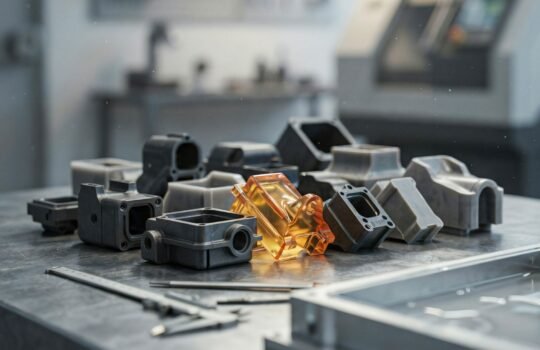
Grippers aren’t the only part of a robot that benefits from additive manufacturing. Across humanoid, four-legged, insectoid, and cobot (collaborative robot) platforms, a wide range of structural and functional components are now routinely 3D printed, including:
- Chassis and structural frames that need a favorable strength-to-weight ratio
- Joints and linkages with complex internal geometry that would be difficult to machine
- Sensor mounts and camera housings that require tight tolerances for accurate alignment
- Battery enclosures shaped around the robot’s internal layout rather than a generic form factor
- Gear housings that combine structural strength with precise fit
- PCB and electronics enclosures that protect control boards while matching the robot’s exact internal space
Tesseract’s electronics and PCB design service pairs naturally with this, since printed enclosures and mounts often need to be built around a specific board layout rather than a standard housing.
5. Drone Components: Strength Without the Weight Penalty
Drones are one of the clearest examples of where additive manufacturing earns its place in a robotics production process. Frames, arms, and mounts need to survive vibration and impact while staying light enough not to eat into flight time.
3D printing supports this with engineering-grade materials built for exactly this trade-off, including carbon-fiber-reinforced filaments and high-performance polymers, letting aerodynamically efficient shapes be printed directly instead of moulded.
6. Material Choice: Matching the Printing Process to the Part’s Job
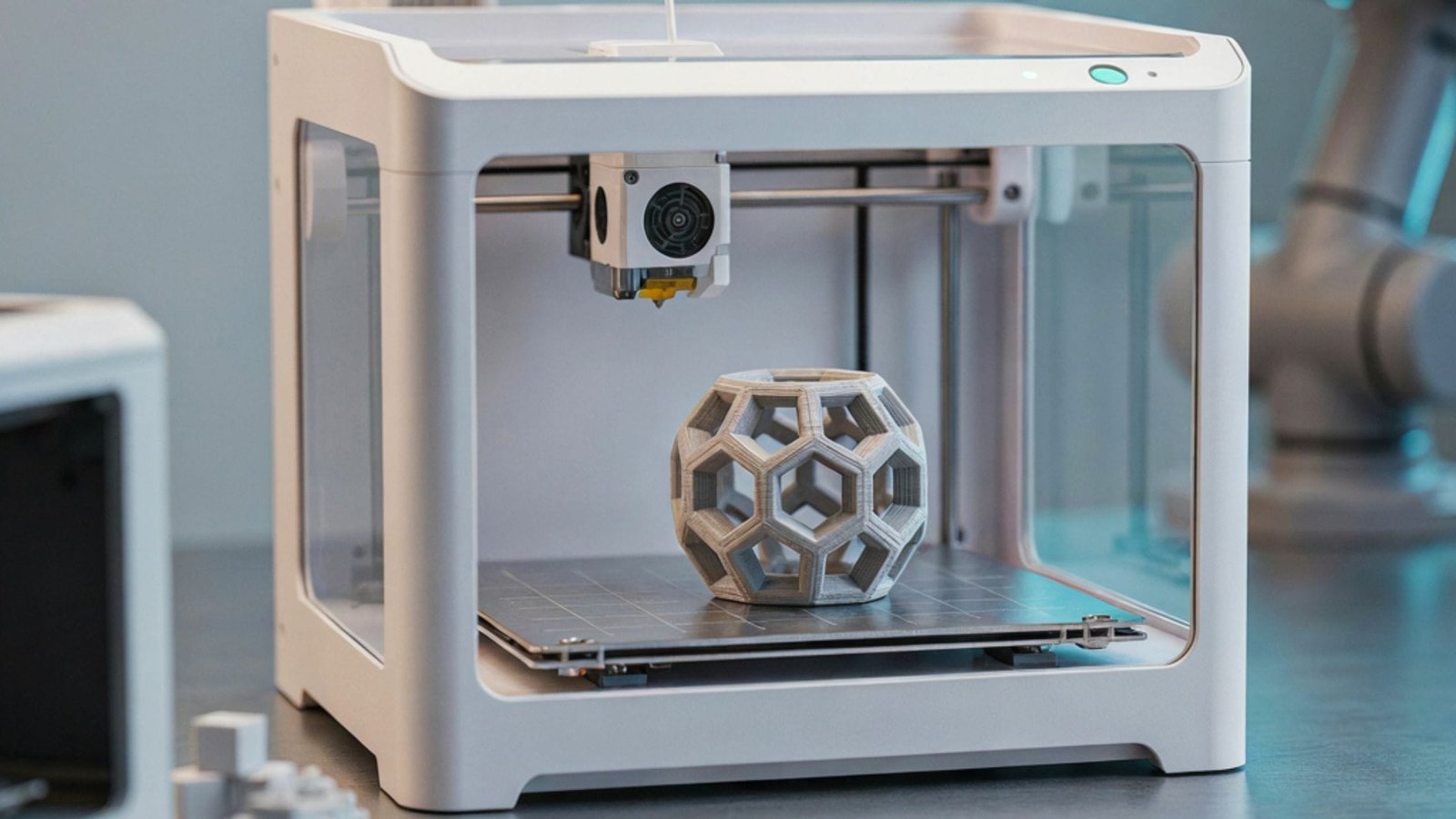
Not every robotics part needs the same material properties, and this is where 3D printing offers a real advantage over single-process manufacturing. Depending on the process, robotics teams can choose from:
- FDM engineering plastics such as Nylon PA6, ASA, PETG-CF, and carbon-fiber-reinforced filaments for structural brackets and housings that need toughness with low weight
- High-performance FDM polymers like PEEK, PEKK, and PEI (Ultem-class materials) for parts that must handle heat or chemical exposure
- SLS nylon powders for functional, snap-fit, and living-hinge components that need durability without support structures
- DMLS metals such as titanium (Ti64), aluminum (AlSi10Mg), and stainless steel 316L for load-bearing metal parts that still need to be lighter than machined equivalents
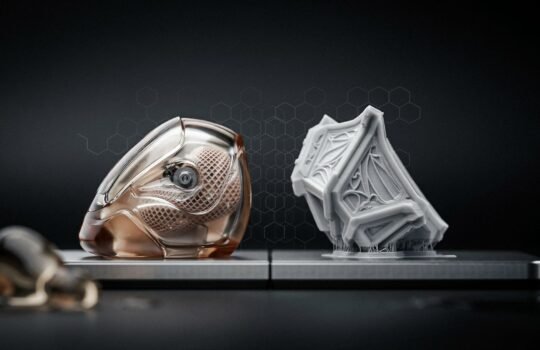
- SLA and DLP resins for high-precision components like sensor mounts, small gears, and housings that demand tight tolerances
Matching the process and material to the part’s actual job is what separates a robotics component that performs well from one that just looks right on the bench.
7. From Prototype to Small-Batch Production
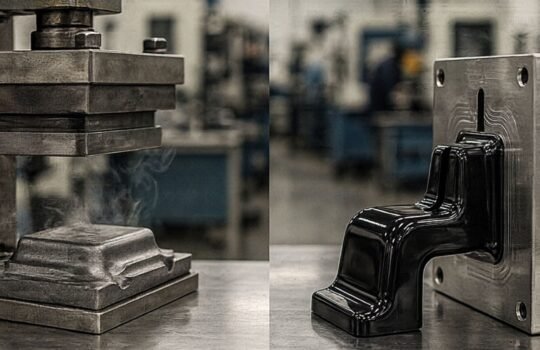
Not every robotics part needs mass-production tooling, especially in the early stages of a product line. 3D printing bridges the gap between a one-off prototype and full-scale manufacturing by supporting small-batch runs of functional parts without the upfront cost of injection moulds. This also helps with low-volume, high-mix production lines where dozens of part variants might be needed, but each only in small quantities.
The same flexibility extends past launch. A bracket, housing, or gripper component that wears out or breaks in the field can be reprinted from the original CAD file instead of waiting on a supplier’s stock or a fresh mould, which matters most in automation lines where downtime is costly. It also lets several machined or moulded pieces be redesigned into one printed component, cutting down on fasteners and assembly time.
8. Post-Processing for Production-Ready Parts
A printed part isn’t always ready to bolt onto a robot straight off the printer. Post-processing steps such as heat treatment, sandblasting, powder coating, and electroplating are often used to bring 3D-printed robotics components up to the surface finish, durability, and dimensional accuracy that final assemblies require.
For metal parts made with DMLS, post-processing can also relieve internal stress and improve mechanical properties. This step is what makes the difference between a part that’s good enough for a design review and one that’s ready for a working robot in the field.
Final Thoughts
3D printing has moved from a prototyping tool to a core part of how robotics and automation companies design, test, and produce components, giving teams a manufacturing path that keeps pace with how fast the industry is innovating.
Tesseract offers FDM, SLA, SLS, DMLS, DLP, and other 3D printing processes for robotics and automation projects, along with post-processing and small-batch manufacturing support, from prototype through to functional, production-ready parts.
Frequently Asked Questions
Is 3D printing strong enough for functional robotic parts?
Yes, when the right process and material are chosen. Engineering-grade filaments, SLS nylon, and DMLS metals like titanium and stainless steel are routinely used for functional, load-bearing robotics components.
What’s the difference between FDM and SLS for robotics parts?
FDM is generally faster and more cost-effective for brackets, housings, and prototypes, while SLS produces stronger, more durable parts without support structures, which suits complex geometries like hinges and gripper components.
Can 3D printing replace CNC machining for robotics production?
Not entirely. 3D printing is well-suited for lightweight, complex-geometry, and low-to-mid volume parts, while CNC machining is often better for high-precision metal parts or when tighter tolerances are required. Many robotics production lines use both.
How long does it take to get a 3D-printed robotics prototype?
Turnaround typically depends on part complexity and the printing process used, but functional prototypes can often be ready within a few days rather than the weeks required for tooled manufacturing.
Which robot parts are most commonly 3D printed?
Chassis, joints, grippers, sensor mounts, battery enclosures, gear housings, and PCB enclosures are among the most common, since these parts benefit most from lightweight geometry and custom fit.