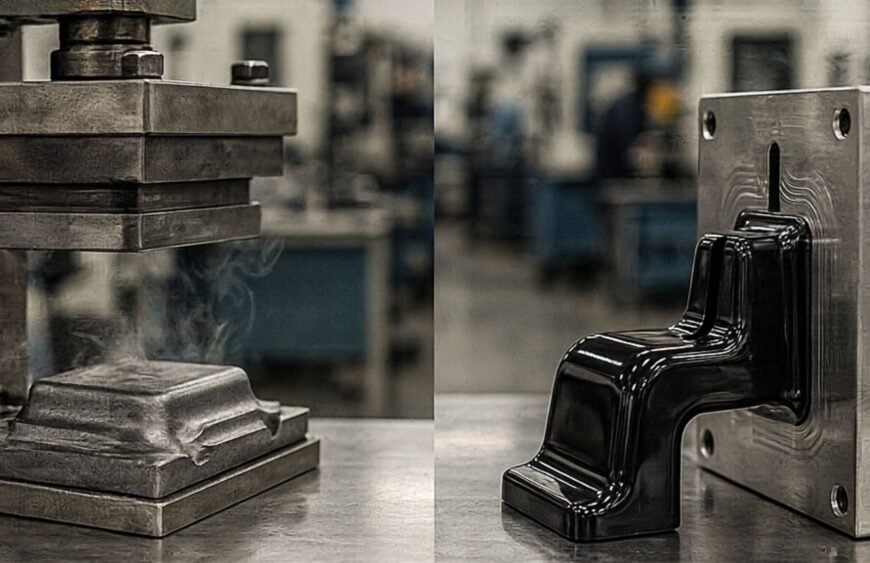
Injection moulding is the better fit when you need large quantities of plastic parts with tight tolerances and repeatable results. Compression moulding is the better fit when your part uses thermosetting materials, composites, or reinforced compounds – especially where material efficiency and biocompatibility matter more than raw output volume.
Below, we break down how each process works, what they’re actually good at, and how to decide between them for your next production run.
What Is Compression Moulding?
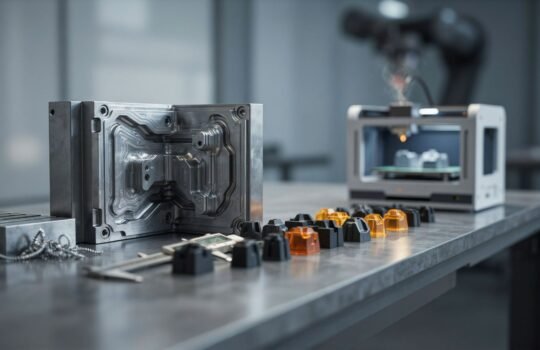
Compression moulding works by placing a preheated moulding material into an open, heated mould cavity. The process typically uses thermosetting resins in a partially cured stage – supplied as granules, putty-like masses, or preforms. Once the mould closes, pressure and heat force the material into contact with every surface of the cavity, curing it into its final shape.
This process is particularly well suited to complex, high-strength fibreglass reinforcements and advanced composite thermoplastics such as rubber and silicone. Because the material is measured and placed directly into the mould rather than pushed through a runner system, compression moulding tends to generate minimal waste – making it a strong choice for expensive or specialty compounds.
At Tesseract, compression moulding is offered for materials including Diallyl phthalate (DAP), epoxy, HDPE, melamine, phenolic resins (PF), PEEK, polyurethane (PU), polyphenylene sulfide (PPS), PTFE, silicone, urea-formaldehyde (UF), and urethane. Parts can be finished with hydro-dipping, hydro-chroming, laser engraving, painting, or sandblasting, and the process supports USP Class VI and ISO 10993 biocompatibility compliance, including ETO and gamma sterilisation.
What Is Injection Moulding?
Injection moulding creates parts by injecting molten material into a closed mould. It works across a wide range of materials, though thermoplastics and thermosetting polymers are the most common. Because the mould is filled under pressure and the part is ejected once cooled, this process is the preferred method for manufacturing plastic components in large quantities.
Designing for injection moulding means accounting for functionality, structural integrity, and the moulding process itself – parts designed around these principles are easier to produce, assemble, and offer enhanced durability over the product’s life.
Tesseract’s injection moulding service works with Polypropylene (PP), ABS, Polyethylene (HDPE/LDPE), Polycarbonate (PC), Nylon (PA), acrylic (PMMA), Polyetherimide (PEI), PC/ABS blends, Polyoxymethylene (POM), styrene, PVC, and TPE/TPU for flexible applications. Custom mould design, first article inspection, statistical process control, and advanced metrology are part of the standard quality process, and, like compression moulding, the service supports USP Class VI and ISO 10993 biocompatibility with ETO and gamma sterilisation.
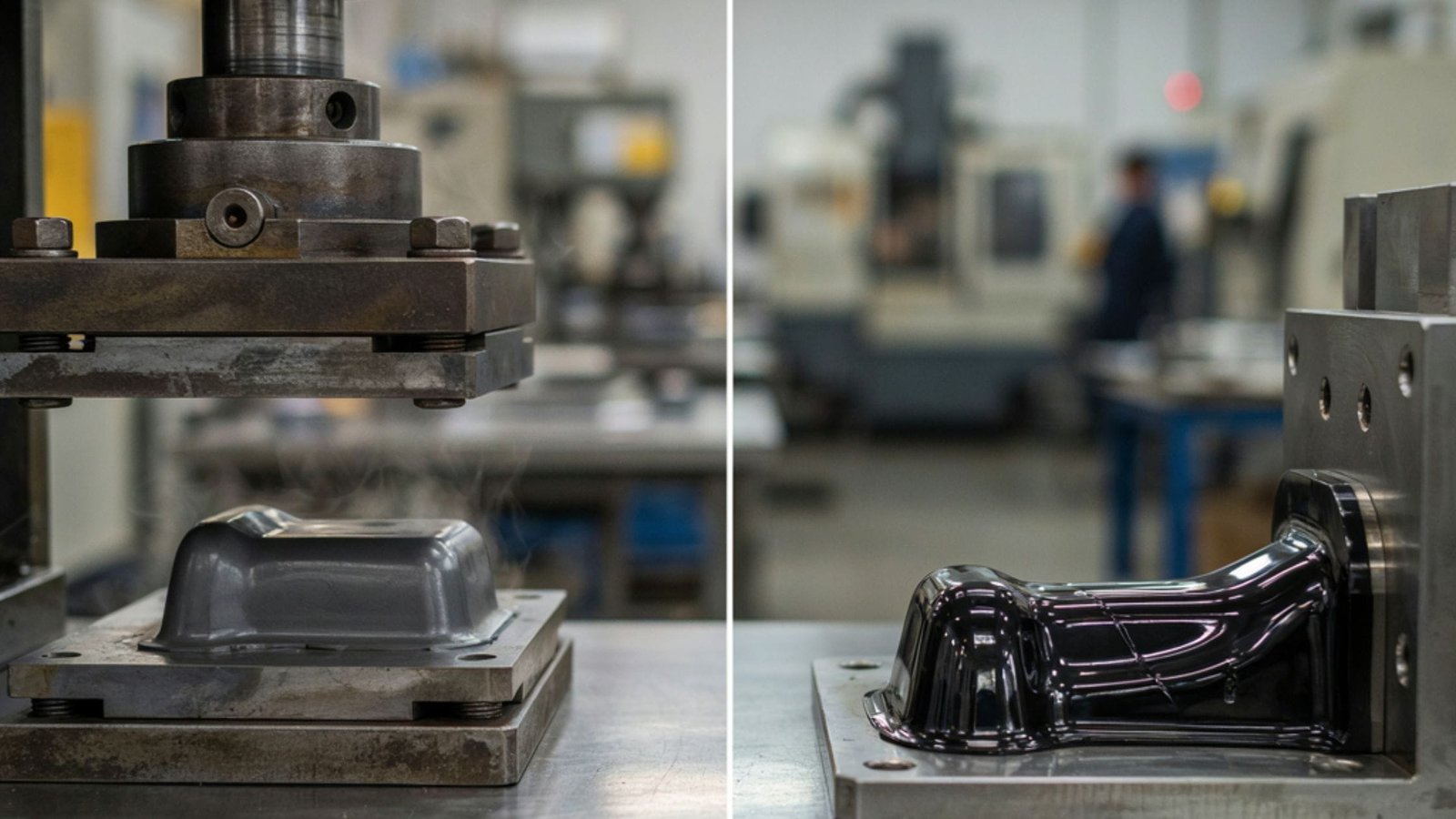
Compression Moulding vs Injection Moulding: The Core Differences
Material behaviour. Compression moulding places a pre-measured, partially cured material directly into an open mould before it’s pressed shut. Injection moulding pushes molten material into an already-closed mould under pressure. This is the fundamental difference that drives everything else – waste, part complexity, and material choice.
Waste and cost. Compression moulding is described as one of the lowest-cost moulding methods available, with minimum material waste, which matters most when the compound itself is expensive. Injection moulding achieves cost-effectiveness differently – through minimal scrap losses and reduced post-processing across a high-volume run.
Production volume. Injection moulding is explicitly the preferred method for producing plastic components in large quantities, with high-volume production, high-tolerance precision, and repeatability as core strengths. Compression moulding’s strength lies in precision scalability for large, fairly intricate parts – it’s built more around handling complex composite geometries than pure unit-volume throughput.
Material range. Injection moulding at Tesseract spans a broad set of thermoplastics – PP, ABS, PC, Nylon, POM, PVC, TPE/TPU, and more. Compression moulding is built around thermosetting resins and composites – phenolic resins, epoxy, PEEK, silicone, PTFE, and reinforced compounds.
Finishing options. Injection-moulded parts at Tesseract can go through anodizing, electroplating, hydro-dipping, hydro-chroming, painting, insert installation, laser engraving, and sandblasting. Compression-moulded parts are finished through hydro-dipping, hydro-chroming, laser engraving, painting, and sandblasting.
Which Process Fits Your Production Run?
If your project needs any of the following, injection moulding is the stronger fit:
- High part volumes. It’s the preferred method for manufacturing plastic components at scale.
- Tight, repeatable tolerances across every unit in a production run.
- A thermoplastic material such as ABS, PP, PC, Nylon, or TPE/TPU.
- A wide range of post-processing options, including anodizing or electroplating.
If your project needs any of the following, compression moulding is the stronger fit:
- Thermosetting or composite materials – phenolic resins, epoxy, PEEK, silicone, or fibreglass-reinforced compounds.
- Cost efficiency on expensive materials, since the process minimises waste.
- Complex, high-strength parts that benefit from fibreglass reinforcement or advanced composites.
- Biocompatibility-critical parts requiring USP Class VI or ISO 10993 compliance with sterilisation support – a requirement both processes at Tesseract can meet, so the material itself often becomes the deciding factor.
Both processes serve aerospace, automotive, consumer, electronics, defence, medical technology, robotics and automation, and toys industries at Tesseract – so industry alone rarely settles the decision. It usually comes down to material chemistry and production volume.
Working With Tesseract
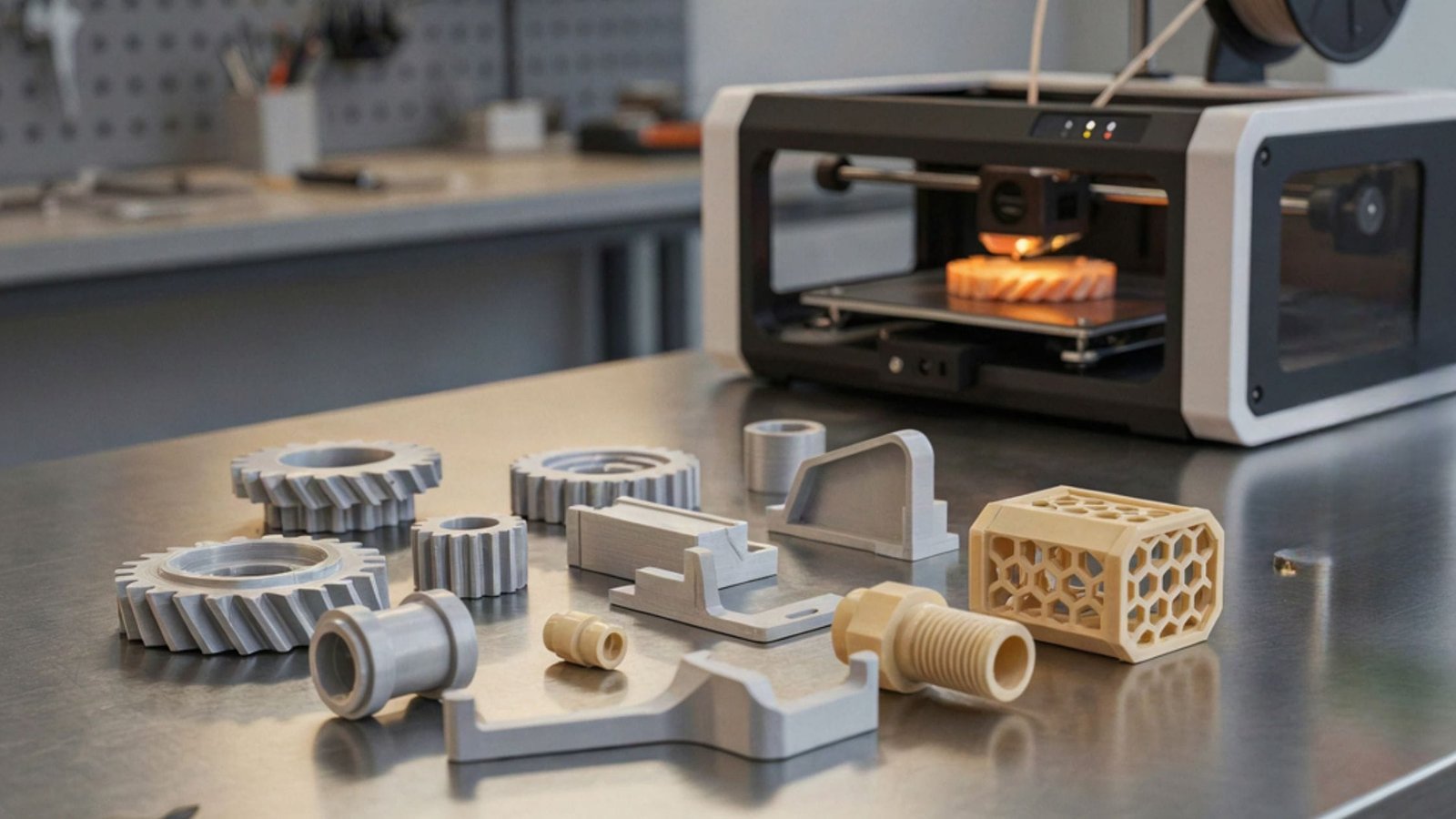
Tesseract is a Mumbai-based product development partner offering design, 3D printing, and manufacturing services, including both injection moulding and compression moulding alongside CNC machining, vacuum casting, metal casting, and sheet metal fabrication. If you’re unsure which moulding process fits your part, sharing your design, target material, and expected production volume with the team is the fastest way to get a clear recommendation and a quote.
Frequently Asked Questions
What is the main difference between compression moulding and injection moulding?
Compression moulding presses a preheated, partially cured material inside an open mould using heat and pressure. Injection moulding injects molten material into an already-closed mould. This difference in process is what makes injection moulding better suited to thermoplastics and high volumes, while compression moulding suits thermosetting resins and composites.
Which process is more cost-effective?
Both are described as cost-effective, but for different reasons. Compression moulding is one of the lowest-cost methods available and minimises waste on expensive compounds. Injection moulding achieves cost efficiency through minimal scrap losses and reduced post-processing, especially at higher volumes.
Can both processes meet biocompatibility requirements?
Yes. Both Tesseract’s injection moulding and compression moulding services are USP Class VI and ISO 10993 compliant and support ETO and gamma sterilisation, so this isn’t typically the deciding factor between the two.
What materials work best with each process?
Injection moulding at Tesseract supports PP, ABS, HDPE/LDPE, PC, Nylon (PA), PMMA, PEI, PC/ABS, POM, styrene, PVC, and TPE/TPU. Compression moulding supports DAP, epoxy, HDPE, melamine, phenolic resins, PEEK, PU, PPS, PTFE, silicone, UF, and urethane.
Is compression moulding suitable for high-volume production?
Compression moulding is built for precision scalability on large, fairly intricate parts rather than pure high-volume throughput. For large-quantity plastic component manufacturing, injection moulding is the preferred method.