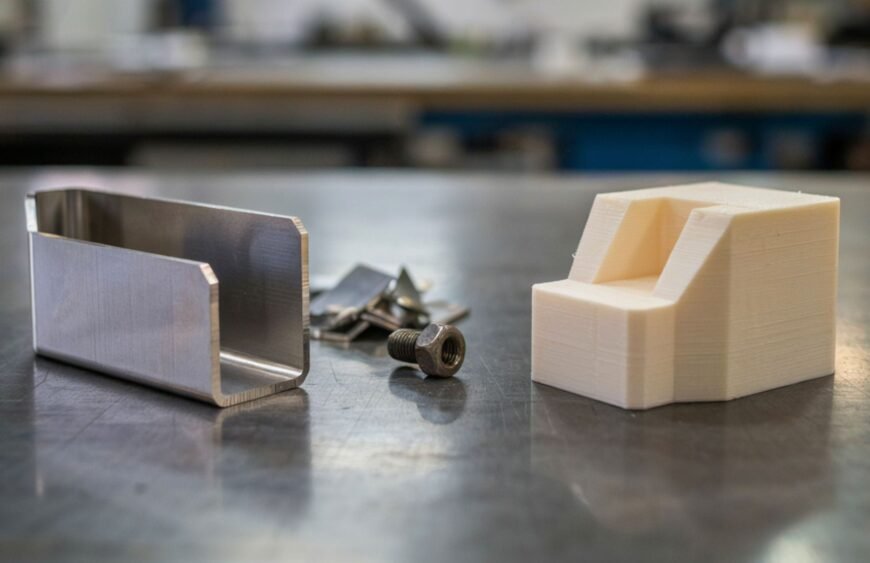
Sheet metal fabrication makes more sense than 3D printing when a part is mostly flat or formed from a sheet, needs metal strength and ductility, is larger than a print bed, or is needed in medium to high volumes where cost per part matters.
3D printing is excellent for complex shapes and one-off parts, but it is not always the most practical or economical route. Knowing where each process is strongest saves money and time, and often improves the final part.
What Fabrication Actually Involves
Sheet metal fabrication turns flat sheets into finished parts through cutting, bending, joining, and finishing. Laser cutting or punching creates the flat profile, a press brake forms bends, and welding, riveting, or fasteners assemble the pieces. Finishes such as powder coating, anodising, or plating complete the part.
Common materials include mild steel, stainless steel (grades like 304 and 316), aluminium (such as 5052 and 6061), galvanised steel, copper and brass. Typical sheet thickness runs from under 1 mm up to about 6 mm, with thicker plate handled by heavier processes.
Where Fabrication Has the Advantage
Volume cost. Laser cutting and press brake bending need little or no dedicated tooling, and material cost per part is low because sheet is an inexpensive starting form. Printed metal parts cost roughly the same each time, while fabricated parts get cheaper as quantities rise and nesting improves material use.
Size. Enclosures, panels, frames, cabinets, and chassis can be metres across. Printing parts this large is usually impractical, while fabrication handles them routinely.
Strength and ductility. Rolled sheet has consistent, well-understood mechanical properties and bends without cracking when designed correctly. That makes it reliable for structural brackets, guards, mounting plates, and load-bearing housings.
Speed for simple geometry. A flat or lightly formed part can go from drawing to finished piece in days, since there is no build time, support removal, or heat treatment step.
Surface finish and tolerances. Laser-cut edges commonly hold around ±0.1 to ±0.2 mm, and bends are typically controlled to roughly ±0.5 degrees. Sheet surfaces are smooth from the start, so finishing is usually lighter than for as-built printed metal.
Where Printing Still Wins
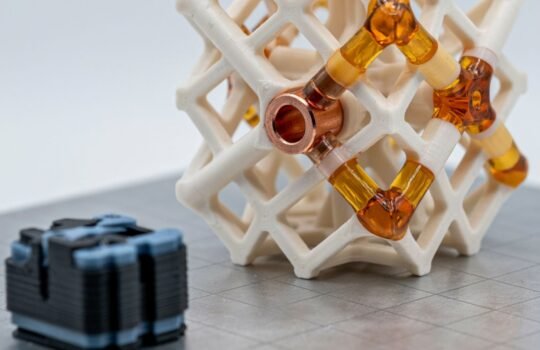
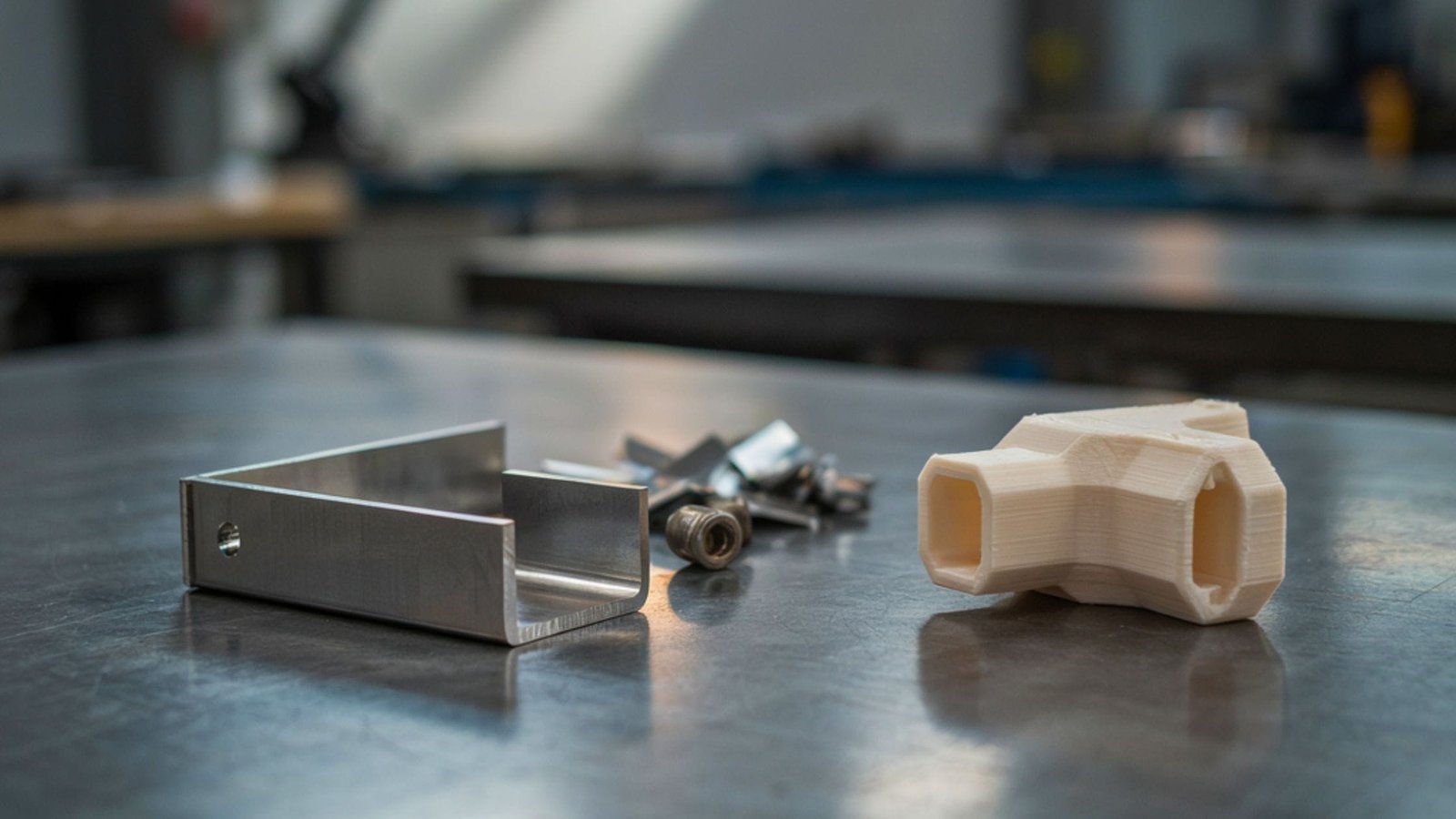
Printing is the better route when the geometry cannot be made from a folded sheet. Internal channels, lattices, organic shapes, undercuts, and consolidated assemblies are natural strengths of additive manufacturing. It is also ideal for very low quantities, such as a single prototype or a custom fixture, where setting up a fabrication programme is not worth the effort.
Weight-critical parts, such as drone components or custom grippers, can also benefit from printed lattice structures that sheet cannot replicate.
Design Rules That Change the Answer
A part that is designed poorly for fabrication can look expensive when it is not. Several basics keep costs down:
- Keep bend radii close to the material thickness to avoid cracking.
- Place holes away from bend lines, generally at least a couple of material thicknesses, to prevent distortion.
- Use consistent thickness and standard bend angles to reduce setups.
- Avoid unnecessary tight corner cutouts and very small features.
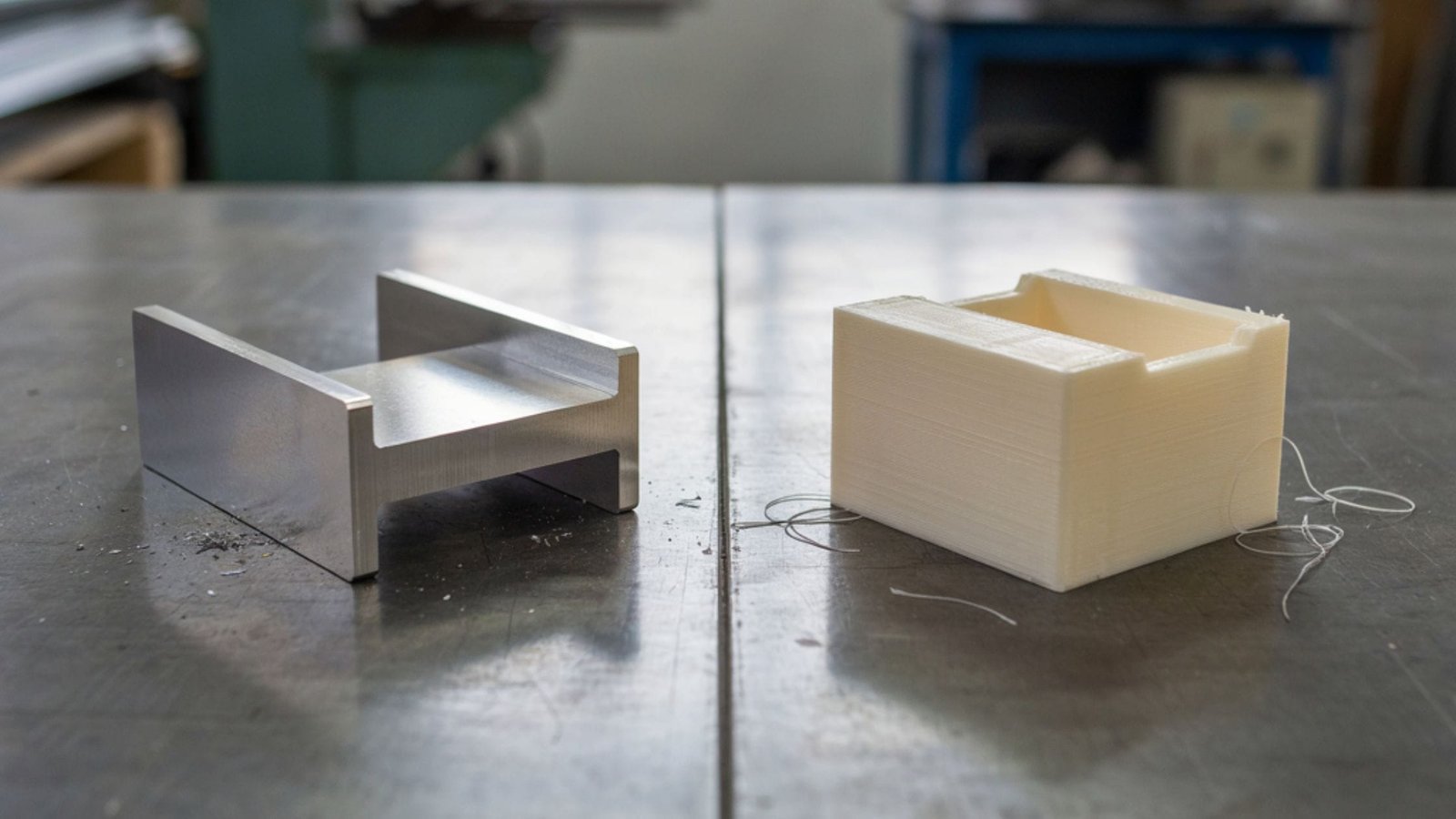
If a printed part is essentially a bracket or enclosure, redesigning it for sheet often cuts cost dramatically with no loss in function.
A Practical Decision Guide
- Choose fabrication for enclosures, brackets, panels, and frames, especially above small batch sizes.
- Choose printing for complex internal geometry, organic forms, or single custom parts.
- Prototype with a printed part to check fit, then move to fabrication for production.
- Combine both when a fabricated frame carries a printed component that is too complex to form from sheet.
Choosing the Right Route with Tesseract 3D
The right choice depends on geometry, quantity, material, and budget. Tesseract 3D, a Mumbai-based manufacturing company, offers sheet metal fabrication alongside FDM, SLS, DMLS, CNC machining, and vacuum casting, so a part can be assessed against every option in one place. Send your CAD file and volume needs to the team, and they can advise on the process that gives you the best result.
Frequently Asked Questions
Is sheet metal cheaper than 3D printing?
For simple shapes and medium to high volumes, yes, because material is inexpensive and tooling needs are low.
Which is stronger, fabricated or 3D printed metal?
Both can be very strong, but rolled sheet offers consistent properties and good ductility, while printed parts depend on material and process control.
Can 3D printing replace fabrication?
Not generally, since large flat or formed parts are far more economical to fabricate.
What is the minimum order for fabrication?
Many shops accept single prototypes, though the cost per part falls noticeably as quantities increase.
Can the two processes be combined?
Yes, many products use fabricated structures with printed components where geometry is complex.