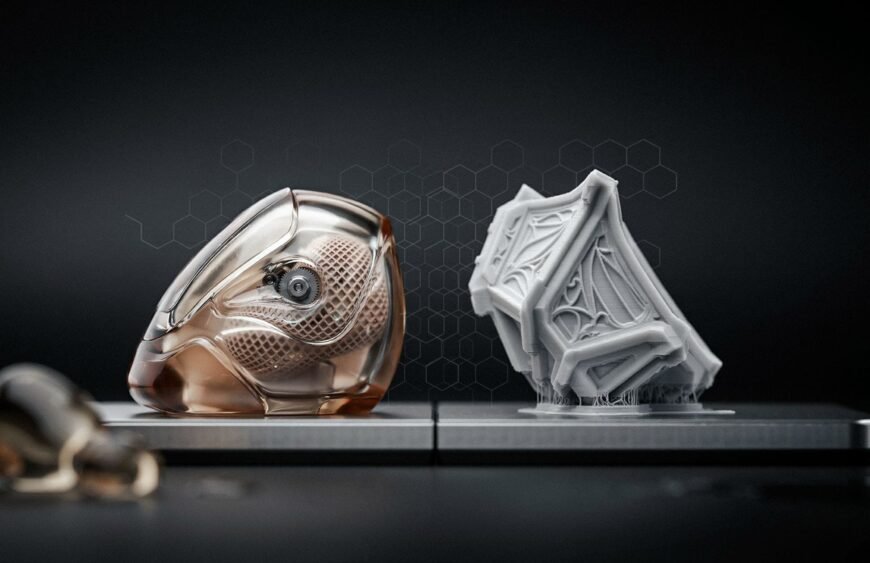
SLA and PolyJet are both UV-cured resin 3D printing processes offered at Tesseract, but they solve different problems. SLA delivers layer resolution as fine as 25 microns, parts up to 1500mm, and a wide range of engineering-grade Accura resins – making it the go-to for functional prototypes, jewellery moulds, and dental models.
PolyJet delivers finer 16-micron layer resolution and can combine multiple materials and colors in a single print, making it ideal for visual prototypes and complex assemblies that need to look and feel like the final product.
How PolyJet and SLA Work
PolyJet is a UV-cured liquid resin process. It uses print heads similar to inkjet technology to deposit resin onto a print bed, curing it instantly with UV light. A distinguishing feature is its gel-like, soluble support material, which makes it possible to produce complex geometries and multi-part assemblies. PolyJet parts come out of the printer fully cured, eliminating the need for post-processing.
Stereolithography 3d printing transforms liquid photopolymer resin into solid objects using a laser or light source that maps and selectively cures each layer. This process repeats layer by layer until the part is complete – making SLA well suited to highly detailed parts, intricate sculptures, jewellery moulds, and prototypes.
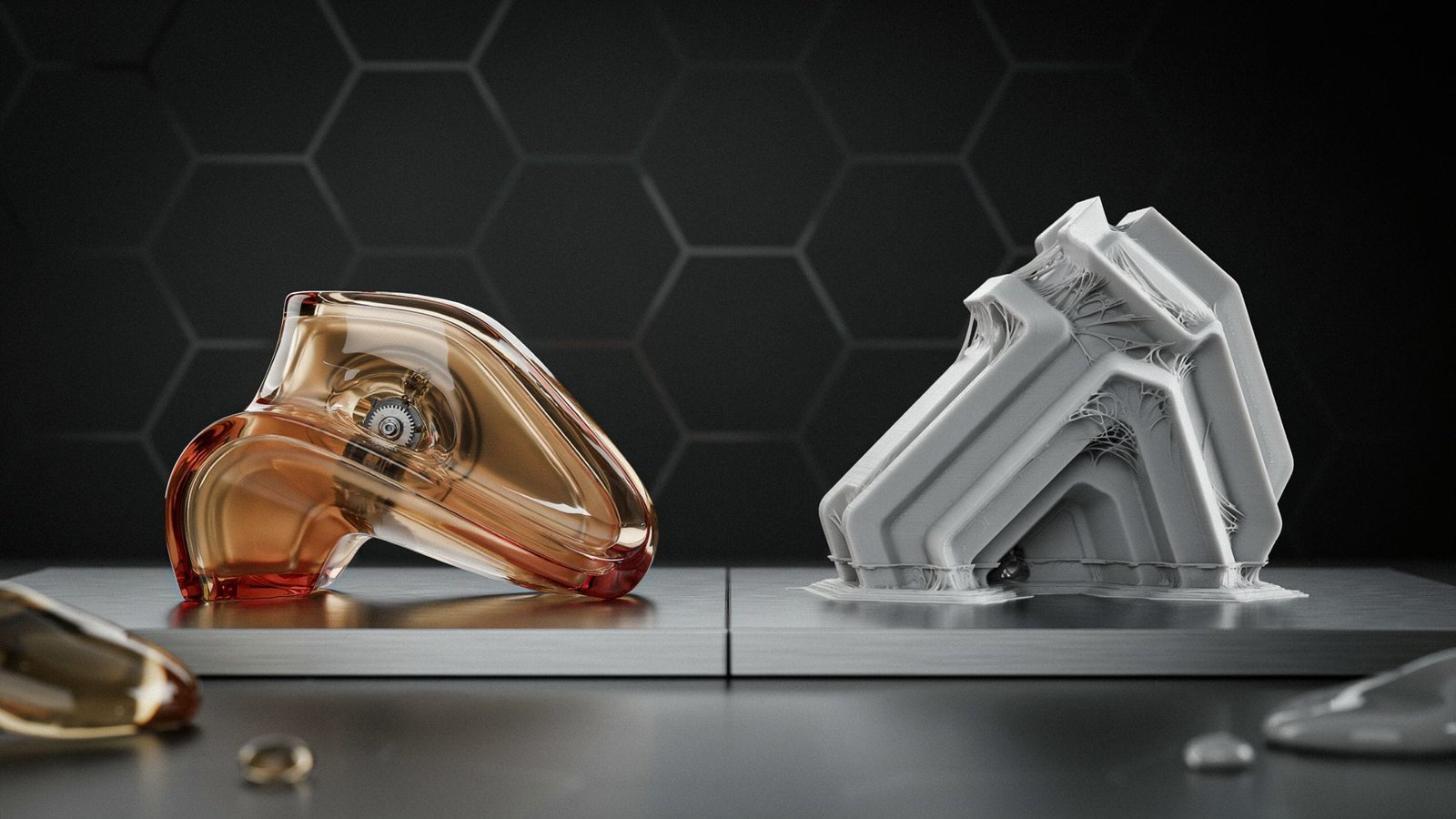
Comparison at a Glance
| Factor | SLA | PolyJet |
| Layer resolution | As fine as 25 microns | As fine as 16 microns |
| Max part size | Up to 1500mm | – |
| Materials | Single resin per part (Accura series) | Multiple resins/colors in one print |
| Surface finish | Smooth, glossy – reduces post-processing | Fully cured off the printer – no post-processing needed |
| Shrinkage/warping | Minimal, dimensionally stable | Not specified |
| Turnaround | Rapid – typically within days | Rapid turnaround for faster design iteration |
| Support structures | Manual removal | Gel-like, soluble support |
| Strength | Exceptional Finish Quality (visual) | Complex Geometries, Visual Prototypes |
Where SLA Wins
SLA is built for accuracy, size range, and material versatility:
- Outstanding Resolution – Layer thicknesses as fine as 25 microns for faithful reproduction of even the smallest design features.
- Versatile Sizing – From small intricate pieces up to 1500mm in length
- Minimal Shrinkage/Warping – Dimensionally stable results, crucial for tight-tolerance parts.
- Quality Surface Finish – Smooth, glossy finish reduces the need for extensive post-processing.
- Material range – The Accura series spans ultra-tough ABS/PP replacements (Accura Xtreme, Accura 55, Accura 25), high-temperature composites (Accura HPC, Accura PEAK, Accura Bluestone), and high-clarity, biocompatible options (Accura ClearVue, Accura CastPro, Accura Fidelity).
- Industries served – Dental models and aligners, jewellery, medical technology, aerospace, automotive, and consumer products.
Where PolyJet Wins
PolyJet is built for visual fidelity and design complexity:
- Precision – Layer resolution as fine as 16 microns, Tesseract finest available resolution.
- Exceptional Finish Quality – Visually striking results with smooth surfaces straight out of the printer.
- Complex Geometries – Intricate internal structures, thin walls, and complex assemblies that are difficult with traditional methods.
- Visual Prototypes – Combines multiple materials and colors in a single print for prototypes that look like the final product and can mimic different material properties.
- Material range – VeroClear (transparent), VeroVivid (500,000+ colors), Tango (soft-touch/rubber-like), Digital ABS Plus (ABS-like), Rigur (polypropylene-like), MED610 (biocompatible medical), and TissueMatrix (mimics organ tissue for surgical simulation).
- No post-processing needed – Parts emerge fully cured.
Tesseract Take: Match the Process to the Part
Both technologies run across Tesseract Mumbai and Boisar facilities as part of a 100+ machine setup spanning FDM, SLA, SLS, DMLS, PolyJet, and DLP. Most projects are completed within 2–7 days.
- Choose SLA if your prototype needs tight tolerances, a large build size (up to 1500mm), or an engineering-grade material – think functional housings, jewellery casting masters, or dental models.
- Choose PolyJet if your prototype needs to combine materials or colors in one part, or needs the finest possible surface detail without post-processing – think multi-material assemblies, biocompatible medical models, or client-facing visual prototypes.
Not sure which fits your part? Share your geometry and end-use requirements, and the Tesseract team will recommend the right process with your quote.
Frequently Asked Questions
What is the difference between PolyJet and SLA 3D printing?
SLA uses a laser to cure liquid resin layer by layer, one material at a time, achieving layer resolution as fine as 25 microns. PolyJet uses inkjet-style heads to jet and UV-cure resin, achieving finer 16- micron resolution and the ability to combine multiple materials and colors in a single print.
Which technology gives finer detail – PolyJet or SLA?
PolyJet offers finer layer resolution, down to 16 microns, compared to SLA’s 25 microns.
What is the maximum part size Tesseract can produce with SLA?
Up to 1500mm in length, covering everything from small intricate pieces to larger models.
Does PolyJet require post-processing?
No – PolyJet parts emerge fully cured from the printer, eliminating the need for extensive post-processing.
What materials does Tesseract offer for SLA printing?
The Accura series, including ultra-tough ABS/PP-like resins, high-temperature composites, and high-clarity biocompatible options such as Accura ClearVue and Accura CastPro.
What materials does Tesseract offer for PolyJet printing?
VeroClear, VeroVivid, Tango, Digital ABS Plus, Rigur, MED610, and TissueMatrix – covering transparent, full-color, rubber-like, and biocompatible applications.
Which industries use SLA and PolyJet at Tesseract?
SLA serves dental, jewellery, medical technology, aerospace, automotive, and consumer product industries. PolyJet is used across aerospace, architecture, automotive, medical, and other industries requiring complex geometries or visual prototypes.
What is Tesseract typical turnaround time?
Most projects are completed within 2-7 days, depending on complexity and technology requirements, with expedited options available.