Whether you’re reverse-engineering a legacy component or validating a production mould, 3D scanning has quietly become one of the most powerful tools in a modern maker’s arsenal. From aerospace factories to orthopaedic clinics, the demand for accurate, fast, and digital-first workflows is reshaping how physical objects are designed, replicated, and manufactured. In this guide, we break down the 7 industries getting the most value from 3D scanning and why the shift is accelerating.
Manufacturing & Industrial Engineering
Manufacturing leads the adoption of 3D scanning for good reason.
Key applications:
- Reverse engineering of legacy parts with no original CAD files
- Quality control and dimensional inspection on production lines
- Tooling verification and die/mould validation
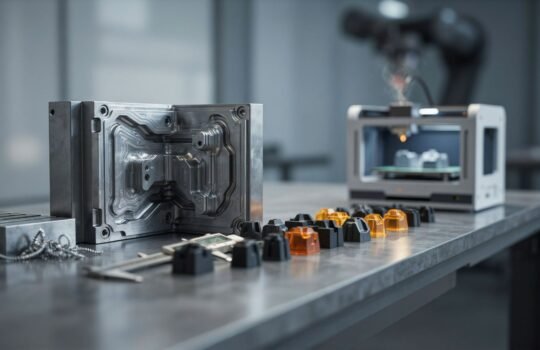
For manufacturers running injection moulding operations, scanning enables cavity-to-part comparison at micron-level accuracy, dramatically reducing scrap rates. When paired with metal 3D printing service workflows, scanned data feeds directly into additive manufacturing pipelines, cutting prototyping cycles from weeks to days.
Aerospace & Defence
Tight tolerances and zero-failure mandates make 3D scanning services indispensable in aerospace.
Key applications:
- Turbine blade and fuselage surface inspection
- MRO (Maintenance, Repair & Overhaul) scanning worn components for remanufacturing
- Digital twin creation for structural analysis
Aerospace MRO teams use scan data, combined with selective laser sintering, to reproduce discontinued or custom components on demand, a process that would previously have required months of sourcing. The ability to capture complex freeform surfaces with sub-0.05mm accuracy makes structured-light and laser scanning essential at this level.
Healthcare & Medical Devices
Precision here isn’t a competitive advantage; it’s a clinical requirement.
Key applications:
- Custom prosthetics and orthotics manufacturing
- Pre-surgical planning using patient-specific anatomical models
- Dental crown, bridge, and implant fabrication
Hospitals and med-tech firms are adopting intraoral and handheld scanners to capture patient anatomy, then converting scans into 3D product design files ready for fabrication. In India, the rise of affordable metal 3D printing services has made patient-specific titanium implants increasingly accessible to mid-tier hospitals, a development that was almost unthinkable five years ago.
Why it matters for makers: Medical device startups building hardware can validate ergonomics and fit using real human scan data rather than generic mannequin geometry.
Architecture, Engineering & Construction (AEC)
The construction sector generates massive amounts of as-built data, most of it inaccurate by the time a project ends. 3D scanning closes that gap.
Key applications:
- As-built documentation for renovation and retrofitting projects
- Heritage conservation and monument digitisation
- BIM (Building Information Modelling) integration
Point cloud data from terrestrial laser scanners feeds directly into BIM platforms like Revit, allowing architects to work from reality-captured geometry rather than hand-measured drawings. For restoration professionals, scan-to-BIM workflows preserve structural and decorative details at a resolution that is impossible to achieve manually.
Automotive & Motorsport
From OEM production lines to custom coachbuilders, automotive teams rely on 3D scanning across the entire vehicle lifecycle.
Key applications:
- Surfacing and clay model digitisation during design
- Aftermarket part reverse engineering
- Crash and deformation analysis
Racing teams in particular use scan data to optimise aerodynamic bodywork and validate fit of composite panels. When combined with selective laser sintering for rapid part iteration, a scan-to-print workflow can produce a functional test component within 24 hours, a critical edge during race-season development.
Consumer Products & Industrial Design
Product designers need physical feedback loops, and scanning delivers them faster than any other technology.
Key applications:
- Scanning handmade or sculpted prototypes into editable CAD
- Ergonomics validation on early-stage models
- Packaging design and form-factor iteration
Designers working on consumer electronics, footwear, or furniture use scan data to bridge the physical-digital divide. A designer sculpts in clay or foam, scans the model, refines it using 3D product design software, and then sends it directly to a metal 3D printing service for functional prototyping, all within the same week.
Cultural Heritage & Education
Museums, archaeologists, and educators are finding genuine value in 3D scanning.
Key applications:
- Digital preservation of artefacts at risk of deterioration
- Reproduction of museum pieces for tactile learning
- Documenting excavation sites with photogrammetry
India’s rich archaeological landscape has seen early-adopting institutions now scanning temple carvings, coins, and manuscript covers for permanent digital archives. Reproductions made via metal 3D printing in India allow handling without risking originals.
Why 3D Scanning Is Now Accessible to Every Industry
The democratisation of scanning hardware from desktop structured-light devices to handheld LiDAR has brought enterprise-grade accuracy to small studios and workshops. Pair that with cloud-based 3D product design pipelines and on-demand metal 3D printing service providers, and the barrier to entry is lower than ever.
Regardless of your sector, the core value proposition is the same: faster iteration, better accuracy, and a direct bridge from the physical world to digital manufacturing.
Conclusion
3D scanning is no longer a specialised tool reserved for large-scale industrial operations. It has become a foundational capability that any maker, builder, or manufacturing business can access and benefit from today.
Across all seven industries covered in this guide, one pattern holds true. The businesses and teams that integrate 3D scanning early in their workflows reduce costly errors downstream, compress development timelines, and produce better-fitting, better-performing end products.
For makers and builders in India, the opportunity is particularly strong right now. The combination of accessible 3D scanning services, growing metal 3D printing infrastructure, and mature 3D product design software means the full scan-to-manufacture pipeline is available at a fraction of what it cost five years ago.
Frequently Asked Questions
What industries use 3D scanning the most?
Manufacturing, aerospace, healthcare, and automotive are the highest-volume users, but adoption is growing rapidly in AEC, consumer products, and heritage preservation.
How does 3D scanning work with metal 3D printing?
Scan data is converted into a mesh or STEP file, cleaned and refined in CAD software, then sent to a metal 3D printing service using processes like selective laser sintering or DMLS to produce functional metal parts.
Is 3D scanning available in India for small businesses?
Yes. Services like Tesseract offer accessible metal 3D printing in India and scanning packages suited to startups, design studios, and SME manufacturers.
What’s the difference between 3D scanning and photogrammetry?
3D scanning uses structured light or laser to capture geometry directly; photogrammetry reconstructs 3D models from overlapping photographs. Scanning is faster and more accurate for engineering applications; photogrammetry suits large outdoor or organic subjects.
Can 3D scan data be used for injection moulding tooling?
Absolutely. Scanned data is used to verify mould cavities, reverse-engineer legacy tooling, and validate part-to-mould fit, making it a standard step in injection moulding quality workflows.